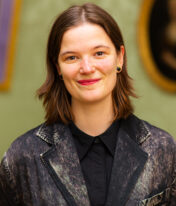
Charley Boerman
Winner Dissertation Prize 2026
Dissertation
Framing Famines: Memory, Museums, and Visual Culture
Supervisors: Prof. Dr. Marguérite Corporaal & Prof. Dr. Lotte Jensen
Co-supervisor: Dr. Ingrid de Zwarte
Nomination: Radboud University Nijmegen, Faculty of Humanities
Shortly after my student days, I decided that eating meat every day was unnecessary, given all the delicious alternatives available. An older relative of mine responded by saying that if he came to my house for dinner, he would insist that I serve meat. Referring to the Second World War and the food shortages of that period, he declared that he would never again accept a meal without meat. His steadfastness and the strong emotion he displayed over what seemed, on the face of it, to be a matter of a beef tartare or a larger helping of mushrooms, illustrate how closely food is tied to the way we see ourselves, experience the world around us and shape our place within it.
Framing Famines: Memory, Museums, and Visual Culture is a remarkably original dissertation that deals precisely with these issues: food shortages and the ways in which we shape our relationship to them. It examines how we even connect our outlook on life and our identities to them. The book examines famine in three European countries and periods: Finland in 1866–68, Ukraine in 1932–33 and Greece in 1941–44. It focuses on a wide range of forms and spaces in which these traumatic memories are preserved, ranging from film to lieux de mémoire and museums. This occurs through both state initiatives and private efforts. Dr Charley Boerman demonstrates that hunger remains an unexpectedly vivid element of memory, commemoration and heritage-making. This is true not only at the local level but also on a national scale, as part of nation-building.
What is particularly fascinating is that Boerman’s analysis shows that hunger has been processed in very different ways. Because these tragedies occurred during occupations by foreign powers, questions of responsibility, perpetration and victimhood play an intriguing role. Furthermore, the immediate processing and acknowledgement of these events was prevented or delayed. The long silence surrounding these events has not diminished their significance. On the contrary, their rediscovery has sharpened contemporary awareness of the historical injustices involved. Within present-day heritage dynamics, this can result in a focus on evil and opposition to an enemy.
Yet it can also be translated into a narrative centred on suffering. This is explored in a chapter on ‘the politicization of the Mother and Child trope’. By focusing on gender, Boerman makes clear that the frequently recurring image of the woman in narratives of hunger did not emerge because women’s personal experiences were regarded as particularly important. Rather, the symbolism of the female figure lies in the relationship between mother and child, evoking innocence, passivity, victimhood and suffering. It once again demonstrates how important it is to continue examining our practices from multiple perspectives.
The jury was unanimous in its appreciation of this critical and refreshing perspective: it has resulted in an original book, written with great fluency. The wide range of subjects covered, from theatres to monuments, does challenge the reader to some extent. However, the clear and carefully structured progression of the book quickly enables readers to become familiar with the material. The decision to adopt a European perspective also contributed to the jury’s choice of this book as one of today’s prizewinners. Moving beyond the stereotypical association between hunger and other parts of the world, Boerman shows that the spectre of hunger is also present much closer to home and is actively deployed in compelling narratives about what binds us together as a community.