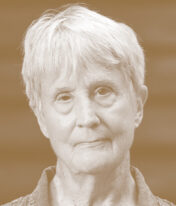
Acceptance Speech
“I am open and I am willing
To be hopeless would seem so strange
It dishonors those who go before us
So lift me up to the light of change”
Holly Near, 2006
The Erasmus Prize is an honor I never imagined receiving. It is a tremendous pleasure and also a responsibility to his Majesty, King Willem-Alexander; to the scientific committee of the PraemiumErasmianum Foundation and its director Geertjan de Vugt; to the staff, especially Lauren Maxwell; to my husband Rusten and brother and sister-in-law Rick and Roberta; to my family and other-than-biological oddkin; and to my unruly friends, students, teachers, and colleagues.
I am in the wake of previous Erasmus recipients. Remembering the colonial massacre and partial resurgence made palpable here last year by Amitav Ghosh, I bob in the seas off Indonesia’s Banda Islands. I am recalled to historical memory by their lingering scent of nutmeg. My task is to cultivate response-ability, the capacity to respond, to be present to what our times and situations demand of us.
This summer, I tripped while picking lemons and fell into the street onto my head. Groggily, I suspected I was auditioning for a role in a murder mystery. Most such shows, in my experience, begin with a woman lying in a pool of her own blood. Instead, I lurched into a months-long whirligig dance of imbalance and doctors’ orders to limit such dangerous things as thinking.
These are unbalanced times, and I am a metaphor. Over the tinnitus ringing in my head, I heard Hannah Arendt’s injunction “Think we must!”; but I was adrift in mandatory thoughtlessness. I was without orientation, not just in Trump world, but in labyrinths of authoritarianism, genocide, war, and ecocide across the Earth. Humans and more-than-humans thrash in tangles of intensifyingcatastrophe.
For any Catholic, lapsed or faithful, a metaphor is never just a metaphor, but embodied meaning-making. We inhabit a concussed world; we are concussed and out of balance. We do not know what to think, how to act, how to matter. We care, but we hardly know how to care for worlds in tatters. In times that trash memories and despise history, we risk losing the capacity to remember how to live and die well with each other. Think we must!
I use the trope of string figures to remember, think, and act. The game of string figures is about inheriting, making anew, and passing on vital patterns together. The game cannot be played alone. It requires giving and receiving, moving and holding still. Isabelle Stengers taught me that. A thinking technology, string figuring is a philosophical, political, and personal proposal.
Tonight, in the Netherlands’ cultural capital, I play a game of string figures to think about a renewed cosmopolitanism without the pathogens of racist and masculinist capitalism, colonialism, nationalism and cultural/religious self-certainty and intolerance, and—core to all of this—human exceptionalism. Depending on the separation of nature and culture, human exceptionalism presumes that all the world is in the service of humanity. Without irony, I speak under the patronage of the Renaissance Dutch humanist, Desiderius Erasmus, who lay groundwork for critical study of the past. Apractitioner of thinking beyond orthodox boundaries, he matters to remembering what our world needs for still possible futures.
I remember that the Netherlands has long been among the world’s most cosmopolitan countries, joining peoples and cultures in histories of shipping, finance, colonization and decolonization, home-making for native born and immigrant, ecological and urban design, and more. Today, peoples from all over call the Netherlands home. The United States and California, my home, are also fraught cosmopolitan worlds. Violence is never far off. Human and more than human, we must knot vital patterns for belonging with and to each other.
I am committed to multispecies cosmopolitanism, including difficult naturalcultural politics after the demise of human exceptionalism. Thinking for Arendt is “training the mind to go visiting”; that is,cultivating the capacity to live and die well in the world in its fundamental otherness from self. I forgive Arendt and Erasmus their resolute humanism because they teach us to think with and withinconsequential difference.
Historical memory is infamously repressed in my country, and perhaps in all nations built on conquest and settlement, forced and unequal labor, and the attempted elimination and replacement of indigenous peoples, plants, and animals. A precondition for a new cosmopolitanism is reckoning with these histories. That is precisely why teaching un-sanitized history in the US is under attack by ourauthoritarian regime. Curricula are destroyed, and professors are disciplined if they anger the fascists. It is why a myriad of books are removed from school libraries, especially books about all women, people of color, and LGBTQ+ people. It is why budgets are slashed and professional staff replaced with compliant functionaries. It is why programming in national parks and exhibits in museums arecensored; these things make ongoing indigenous presence palpable, or understanding the horror of slavery and its aftermath inescapable, or biodiversity destruction unbearable. It is why funds are eliminated from public media and from evidence-based popular history.
As Rebecca Hall wrote in Wake: The Hidden History of Women-Led Slave Revolts, “Black and Indigenous history, which is filled with countless stories of resistance, is erased to control the narrative.” Expunging history and care for place—overwriting them with Man-centered patriotism—is necessary to authoritarian dominance.
I think too of cyborg apocalypses of censored data, including climate, health, and biodiversity websites. Challenging these erasures, technologically savvy activists recover information. Meanwhile, energy-guzzling AI data centers remember and think for us (which us?) at unfathomable ecological, social, monetary, and spiritual costs. Still, I affirm liberatory cyborg practices and innumerable acts of scientific resistance. We refuse to forget what we need to know for habitable histories to come.
Cyborg apocalypses bring us to Russian drones raining death in Ukraine. The life-giving potential of drones, for example: for ecological restoration, is swamped by a cyborg arms race. But also, memory of outrages gives strength to resurgent alliances. I embrace my old slogan, ‘Cyborgs for Earthly Survival.’
Geospatial remembering turns me toward Israel-Palestine, where endless US weapons enable catastrophe. Pulverizing Gaza, one of the oldest urbanized centers on Earth, has been many things, not least the reduction to dust of the history of a land and its human and more-than-human inhabitants. Genocide, ecocide, and erasure of futures constitute the war and occupation project that imperils all living beings from the river to the sea. But the land remembers its ghosts.
My gyrating memories next spin a speculative fabulation of Greater Mexico, with its diverse humans, insects, mammals, plants, and birds. Latin America is easily forgotten in attention to Gaza, Ukraine, South Sudan, and more. But the Americas are my home, and I invite you to refigure history with me.
What if Mexico had won the war in 1848 against the United States? Asking this question might be critical for demolishing mental and physical border walls for humans and more than humans. The Treaty of Guadalupe Hidalgo ceded the vast territory of northern Spanish Mexico, including what is now California. Instead of recognizing that history, the US attempted to erase Mexican and Indigenous past and ongoing presence and exclude living beings from crossing the treaty line. As Texas political scientist José Angel Gutiérrez put it, “We didn’t migrate here or immigrate here voluntarily. The United States came to us in succeeding waves of invasions.” Migrating butterflies, pig-like javelinas, jaguars, and Sonoran pronghorn antelope, as well as Tohono Oo’dham visiting relatives and the Hispanos of New Mexico, might well say the same thing.
What if I lived today in Greater Mexico instead of the United States, with its official masked thugs disappearing brown-skinned residents into detention camps? Would I face expulsion as an unwanted other taking work and benefits from those who rightfully belong? Of course, these erasures and seizures have been continuously challenged; and longing for a free, conjoined land infuses multi-racial, pro-migrant activism now.
The Texan-Mexican-Californian lesbian feminist theorist and poet Gloria Anzaldúa remembered that borderlands are fertile places of meeting and sharing, even in the teeth of militarized, sterilized frontiers that make going visiting deadly. Migrants depend on healthy habitat along their entire route. From a drone’s-eye view, these zones are a fragmented moonscape. No hungry song bird or thirsty refugee has a chance. But I remember that the 2000-mile borderlands between Mexico and the US remain among the continent’s most diverse naturalcultural worlds, where “going visiting” for living and dying well is at stake for human beings and 700+ species of birds, mammals, and invertebrates. It is past time to reclaim these lands.
Anzaldúa knew storytelling is critical to flourishing. So, I end with a story of feminist science studies, my scholarly home, and the journal Tupuya: Latin American Science, Technology and Society. The name derives from the Quechuan “tapuy”— “to question, to investigate.”
This word ties me to the memory of my friend and colleague Sandra Harding, who died this year. Sandra proposed what she called “strong objectivity” to ground knowledge-making in less biased, more capacious practices. In co-founding the journal, Harding collaborated to build decolonial science studies with scholars like Tania Pérez of Colombia and Leandro Rodriguez of Chile, bringing ignored Latin American approaches to readers globally.
We seek to remember, and we find new balance. We fall out of self-certainties; we go visiting. We relearn how to think with each other, human and more than human. We must be willing to fall, trusting that we will be caught in a web of mutual thought and care. We seek healing from concussion.
As Schutzhund dog training teaches us: Run Fast, Bite Hard!
Recalling “In Praise of Folly,” published in 1511, with its biting satire of human moral delusions, I think Erasmus might approve.